by Noelle Vlasov
If you cut Miles Aldridge open, he bleeds cherry red. Acid-bright and unnervingly sweet. His world of neon cake, ornate to the point of toxicity. As he puts it himself: “If bottled, it would taste like dish soap and cigarettes.” A world where deliberation is obsessive and obsession is controlled. Endless copies of what seems to be the same woman, draped in technicolour shadows. She sits flawlessly arranged like a doll, in pictures where
everything is spliced together like a parody of perfection.
For decades, Aldridge has distilled his fever reveries into stills, frozen in time, capturing the madness of cinema within the rigid limits of print. But lately his dreams have seeped out of frame. They move, flicker, and unravel. ‘I’ve just finished my first script.’
Miles Aldridge is making a film.
But now we’re in his photography studio, hidden behind a bright, cherry-red door. A warning or invitation, depending on the observer’s disposition and how absurd their tendencies. An orange piano lights up the middle of his pristinely white studio like a bonfire, blazing with inspiration, and for me, with distraction. To play or not to play? That is the question.
‘The last person that sat there was Elton John.’
Not to play.
‘I just shot Elton for Times magazine, at his place in Windsor against an orange background. He was holding all sorts of props, it was a photo-booth style shoot. Very colourful. Very pop.’
Very colourful and very pop is indeed applicable to the entirety of Aldridge’s work. Almost. There has been one photo I’ve seen of his that was black and white, which inherently feels like some sort of error. Whatever must have prompted that? ‘Oh, that was done deliberately because I had an exhibition called One Black and White Photograph and 24 Colour Photographs.’ Outnumbered by the 23, the 1 does not flinch, and somehow remains just as brightly ingrained in one’s mind. ‘Warhol, Lichtenstein…they both introduced incredible black and white work as well - pop can be black and white. I’ve been asking myself if I should do a black and white series, to surprise, and question what I’m doing. I haven’t come up with an answer, but I do like that idea.’
Black and white can be pop, but could it truly be Miles Aldridge? After all, colour appears essential to the careful construction of his primary dimension. One of seductive beauty laced with fluorescents, a combination that proves to be as distracting as possible. Distracting from his secondary dimension, where the neons and pastels are contrasted by the darkness of his themes. ‘The origin is my mother. As a young man, I observed her going through her divorce. It was pretty violent, and I think of the crisis that was buried within her. But her face was very poker-like.’ Upon a closer look, his work reveals a domestic dystopia of moral decay. Magenta pink turns from passionate to violent, and the lime green that made us lively now makes us sick. ‘In great art, the message is hidden. Almost as though the message doesn’t come first, the image does.’ Aldridge sugarcoats the darkest truths in layers of candied lacquer, watching - to see who will admire the shine and who will notice. ‘Well, Anna Wintour said to me... She said, ‘There’s something weird about this
picture. What is it?’ And I said, ‘I don't know, I don’t see anything weird about it.’
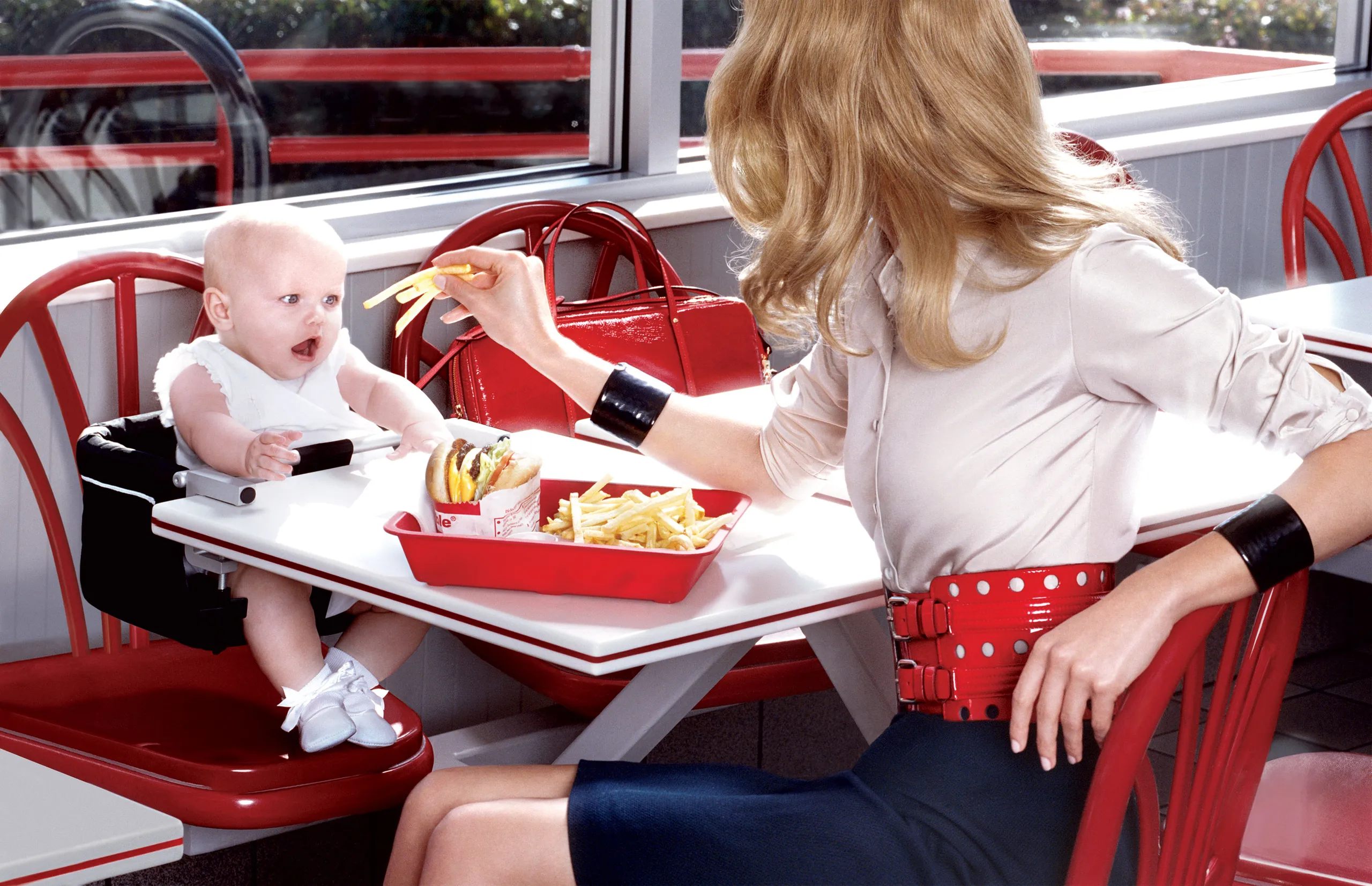
The picture in question was of a mother feeding her child French fries, which was indeed published in American Vogue. ‘They got letters saying, how could you show a mother feeding French fries to a baby’, he recalls. 'I knew it was wrong. Obviously you shouldn't feed babies French fries. It was just the most irresponsible thing to show. But that’s why I did it. I’m in America, I thought. Everyone’s obese. French fries are the most American thing. It’s a commentary on bad parenting. I thought it was something that the American people should think about.’
His work seems to always be a question instead of an answer. ‘The culture otherwise is like a giant aspirin that makes people docile and pliable to the stupidity of advertising. I want my images to stain your brain a bit longer - to make people question who they are, why they are.”But we travel from society to the individual, as his sources of creativity shift from the conscious to the subconscious. ‘Sometimes I dream ideas’ Aldridge says, thumbing through Federico Fellini’s ‘Book Of Dreams’, ‘Fellini would wake up and sketch his dreams, use them as inspiration. I tried that - even went to therapy to analyse my dreams. But by the end, I got distracted and did other things in therapy, not my dreams. ’ It comes as no surprise that Aldridge’s influences include filmmakers such as Fellini or Lynch - directors who also revel in unease and uncertainty. I cannot help but wonder, will his own film echo these liminal themes?
‘I’ve just finished the script, and hopefully it will be made by the end of this year.’ Not much is revealed, which is expected. But he does hint that the film will exist in an ambiguous time period - ‘People will have mobile phones, but everything else will be out of place.’ Both retro and contemporary, rather like his previous work. And rather like a dream. But what will it be about?
Aldridge smiles a pastel smile. ‘As the movies have shown you, we’re interested in beautiful people who do weird things.’
April 2025
miles aldridge
on beautiful people who do weird things
